

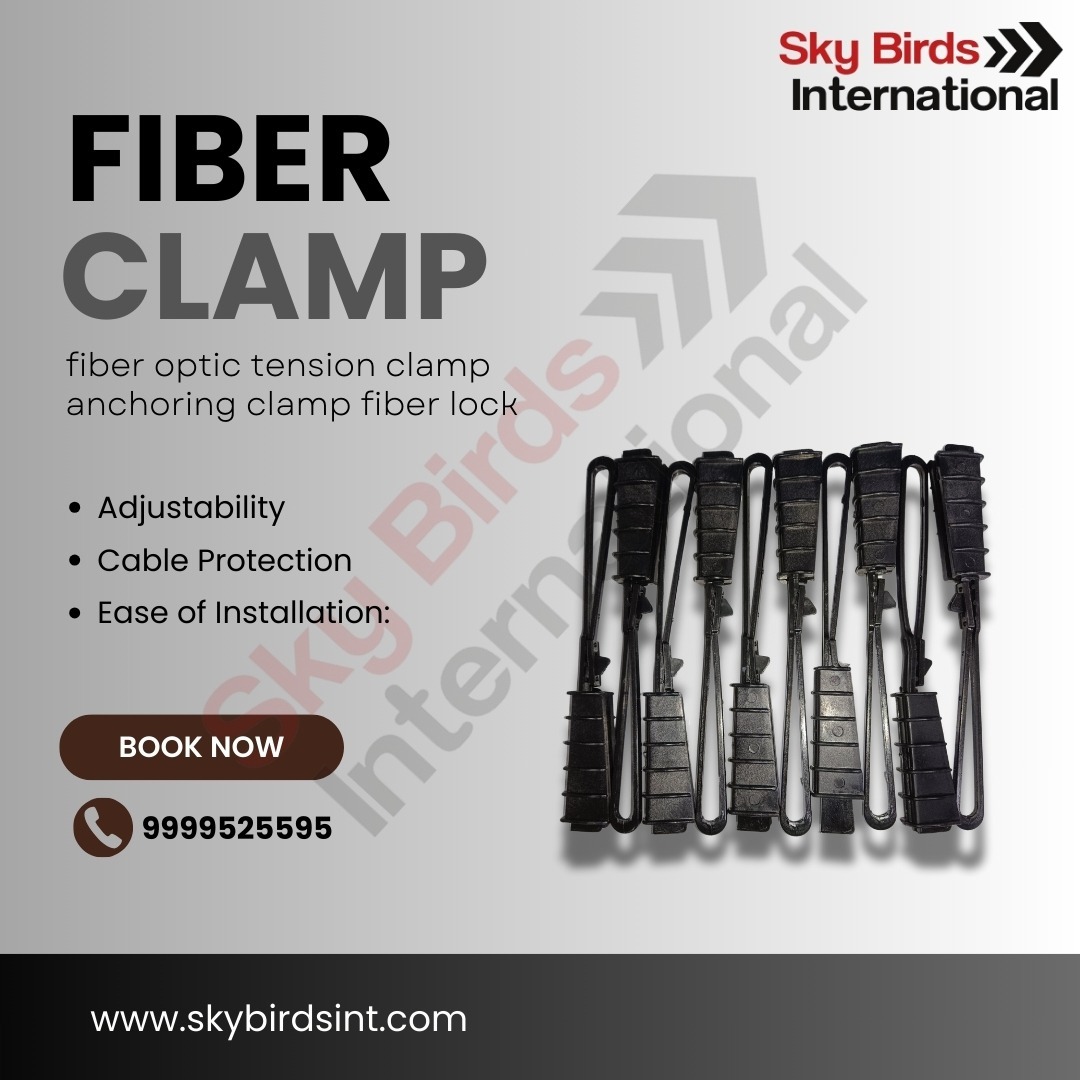
Fiber clamps are essential mechanical devices used to secure, stabilize, and protect fiber optic cables during installation and operation. Their primary functions include providing strain relief, preventing mechanical damage, organizing cable routes, and ensuring the long-term stability and reliability of the network infrastructure.Types of Fiber Clamps and Their Applications
Different clamps are designed for specific installation scenarios, particularly in aerial or Fiber-to-the-Home (FTTH) networks:
Drop Wire Clamps: Commonly used in FTTH networks to secure the fiber drop cable (flat or round) from a utility pole to a building entry point.
Fish-type (Saddle) Clamps: Ideal for securing cables along walls or flat surfaces, offering a secure grip without crimping.
S-type Clamps: Feature an 'S' shape used to secure messenger wires of self-supporting drop cables to hooks or brackets.
Tension Clamps (Anchor Clamps/Dead-end Clamps): Used at points of high mechanical stress, such as terminal poles, angle points, or dead ends of a cable run, to bear the cable's full axial load.
Wedge-Type: Feature a self-tightening wedge mechanism that increases grip as tension rises, often requiring no special tools for installation.
Helical (Preformed) Tension Clamps: Use preformed rods that wrap around the cable, distributing the gripping force over a larger area to minimize stress on the cable.
Suspension Clamps: Used on intermediate (tangent) poles in aerial installations to support the cable's weight and prevent sagging, allowing some flexibility while not gripping under full tension.
Lashing Clamps: Used to secure fiber optic cables by lashing them to a separate support or messenger strand running between poles.