

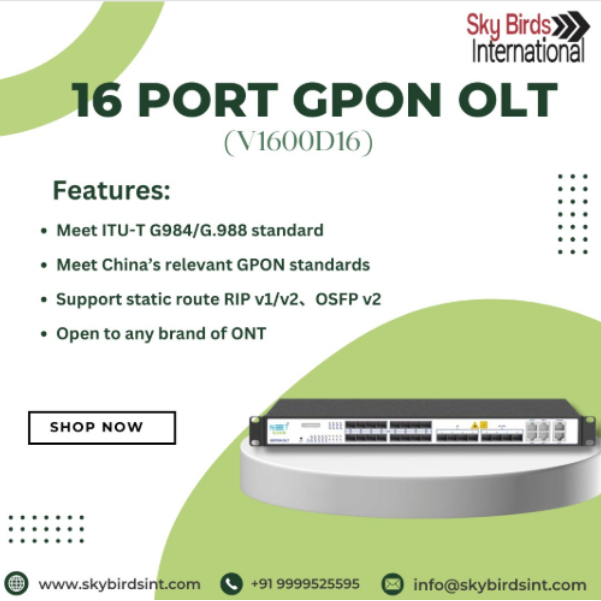
A 16-port GPON Optical Line Terminal (OLT) is a high-density, carrier-grade network device designed to deliver fiber-to-the-home (FTTH) and enterprise-level broadband services. Housed in a compact 1U rack-mountable chassis, it acts as the central hub of a Gigabit Passive Optical Network (GPON), managing traffic between the service provider's core network and end-user devices (ONUs/ONTs).
Core Technical Specifications
Most 16-port GPON OLTs in 2026 follow standardized performance benchmarks:
Capacity: Each of the 16 PON ports supports a 1:128 splitting ratio, allowing a single 1U device to serve up to 2, 048 subscribers simultaneously.
Data Rates: Standard speeds include 2.488 Gbps downstream and 1.244 Gbps upstream per port.
Uplink Interfaces: Typically equipped with 4 to 8 GE (Gigabit Ethernet) RJ45/SFP ports and 2 to 4 10G SFP+ ports to provide high-speed backhaul.
Distance: Reliable optical transmission covers up to 20 km.
Reliability: Many models feature dual hot-swappable power supplies (AC, DC, or mixed) to ensure 24/7 operation.
Key Features & Management
Advanced Networking: Supports Layer 3 switching, including static routing and dynamic protocols like RIP/OSPF for efficient traffic management.
Service Quality: Incorporates Dynamic Bandwidth Allocation (DBA) and Quality of Service (QoS) based on MAC, VLAN, or TOS to prioritize voice and video traffic.
Management Modes: Administrated via CLI, Web interface, SNMP, Telnet, or SSH. Centralized management often uses an Element Management System (EMS).
Security: Includes features like ACL (Access Control Lists), broadcast storm suppression, and data encryption (AES-128) over PON interfaces.
Typical Applications
Residential FTTH: Providing high-speed internet, IPTV, and VoIP to high-density urban areas.
Commercial Use: Enterprise LANs, VPN services, and campus-wide fiber networks.
Smart Infrastructure: Video surveillance (IP camera) networks and Internet of Things (IoT) backhaul.
Leading manufacturers of these devices include VSOL, TP-Link, Huawei, and C-Data.